
SURABAYA — Universitas Nusa Cendana (Undana) participated in the 2026 Indonesian Higher Education Summit Conference (KPPTI), held at the Airlangga Convention Center (ACC), Universitas Airlangga (Unair) MERR-C Campus, Surabaya, on 11–13 November 2026.
Its participation demonstrated the institution’s contribution to expanding national cooperation networks and strengthening a higher education ecosystem that benefits communities.
The KPPTI 2026 innovation exhibition gave Undana a platform to present the theme “Empowering Semau Island Communities through Local Knowledge and Student Innovation to Strengthen the Community Economy, Develop Coastal Resources and Build Sociocultural Resilience.” The theme reflected Undana’s consistent focus on the local potential of island communities in developing academic innovations.
Attended by more than 2,000 participants from public and private universities and partner institutions, the national conference was officially opened by Minister of Higher Education, Science and Technology Prof. Brian Yuliarto, S.T., M.Eng., Ph.D., on Wednesday, 11 November.
With the overarching theme “Transforming Higher Education towards Impact: Integrating Technology and Local Knowledge in Inclusive and Human-Centered Ways,” the event provided a strategic forum for sharing good practices in higher education management.
Coordinating an Academic Ecosystem that Delivers Solutions
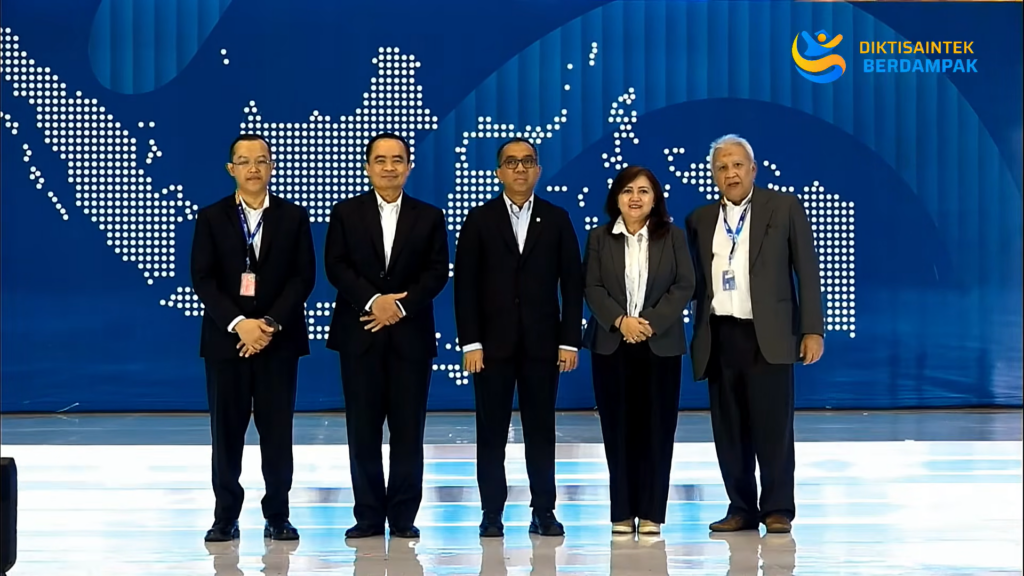
In his keynote address, Minister Brian described Indonesia’s extensive higher education ecosystem, comprising 4,303 institutions, 10.7 million students and 328,000 lecturers. He said this considerable human resource capacity offered enormous potential to bring about changes that people could experience directly.
“We want these solutions to emerge from universities,” Minister Brian told university leaders. He encouraged research agendas, student final projects and community service programs to be integrated in ways that address real problems in regions and industry.
To build a productive academic ecosystem, the Minister emphasized university leaders’ role in coordinating lecturers’ three principal strengths: teaching; research; and community service and industrial cooperation. He said an individual lecturer did not necessarily possess all three capacities, so university leaders needed to create opportunities for these strengths to complement one another.
“This is the function and role of university leaders: to coordinate these three strengths. That is your role as university leaders. University leaders must introduce breakthroughs,” Prof. Brian said.
Alongside stronger lecturer management, he emphasized the need for a sustained culture of research and scholarly publication. Publishing in reputable journals should not be treated merely as an administrative requirement for promotion, but as a record of contributions to knowledge for future generations.
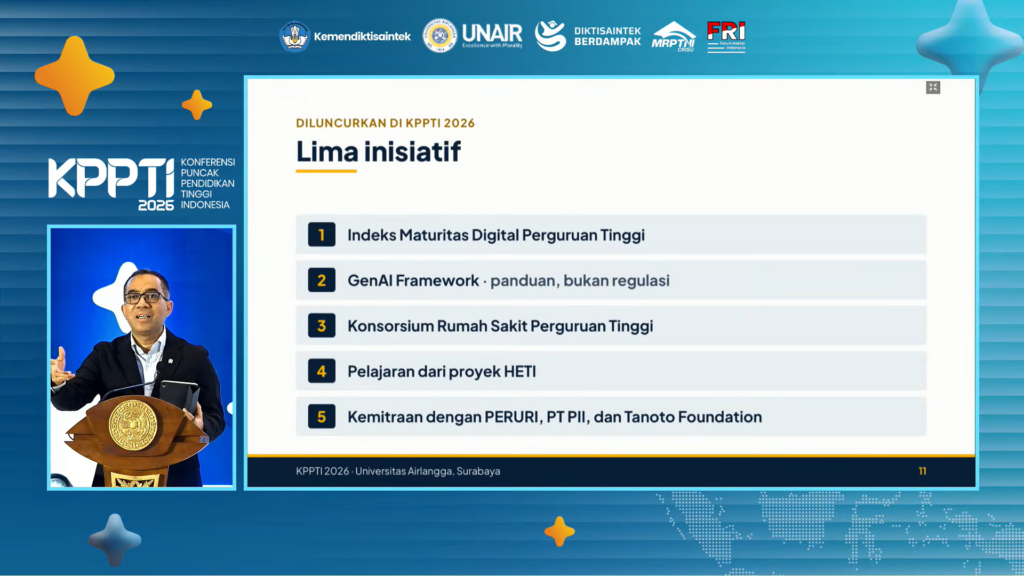
Minister of Higher Education, Science and Technology Prof. Brian Yuliarto, S.T., M.Eng., Ph.D., presenting at KPPTI 2026.
“Journal papers are our public record of science. They are our contribution to knowledge. So do not view them simply as a requirement; they are our contribution to knowledge. Those papers will still be read 20 years from now, 30 years from now,” the Minister said.
Five Strategic Initiatives and Cross-Sector Cooperation
In line with the vision for transforming national higher education, the opening of KPPTI 2026 included the launch of five strategic ministry initiatives: the Higher Education Digital Maturity Index, the Generative AI Framework, the University Hospital Consortium, dissemination of the HETI project, and strategic partnerships with Perum PERURI, PT Penjaminan Infrastruktur Indonesia (PII) and the Tanoto Foundation.
Minister Brian also outlined national policies to expand educational access through scholarships and meet demand for specialists in science, technology and medicine. The government was committed to maintaining affordable higher education while improving the quality of vocational higher education institutions across Indonesia.
Through the exhibition and discussion forums in Surabaya, Undana and other universities are expected to strengthen cooperation among campuses, local government and business to accelerate sustainable innovations grounded in local knowledge.
Concluding his presentation, Prof. Brian Yuliarto encouraged all stakeholders to continue generating tangible change from their respective universities to realize the Golden Indonesia 2045 vision. “The impact of a university’s excellence becomes visible when its knowledge improves existing conditions. That is where change and progress in Indonesia can begin,” he concluded. (Iyl)
Editor: Refael Molina — Photo: Courtesy